

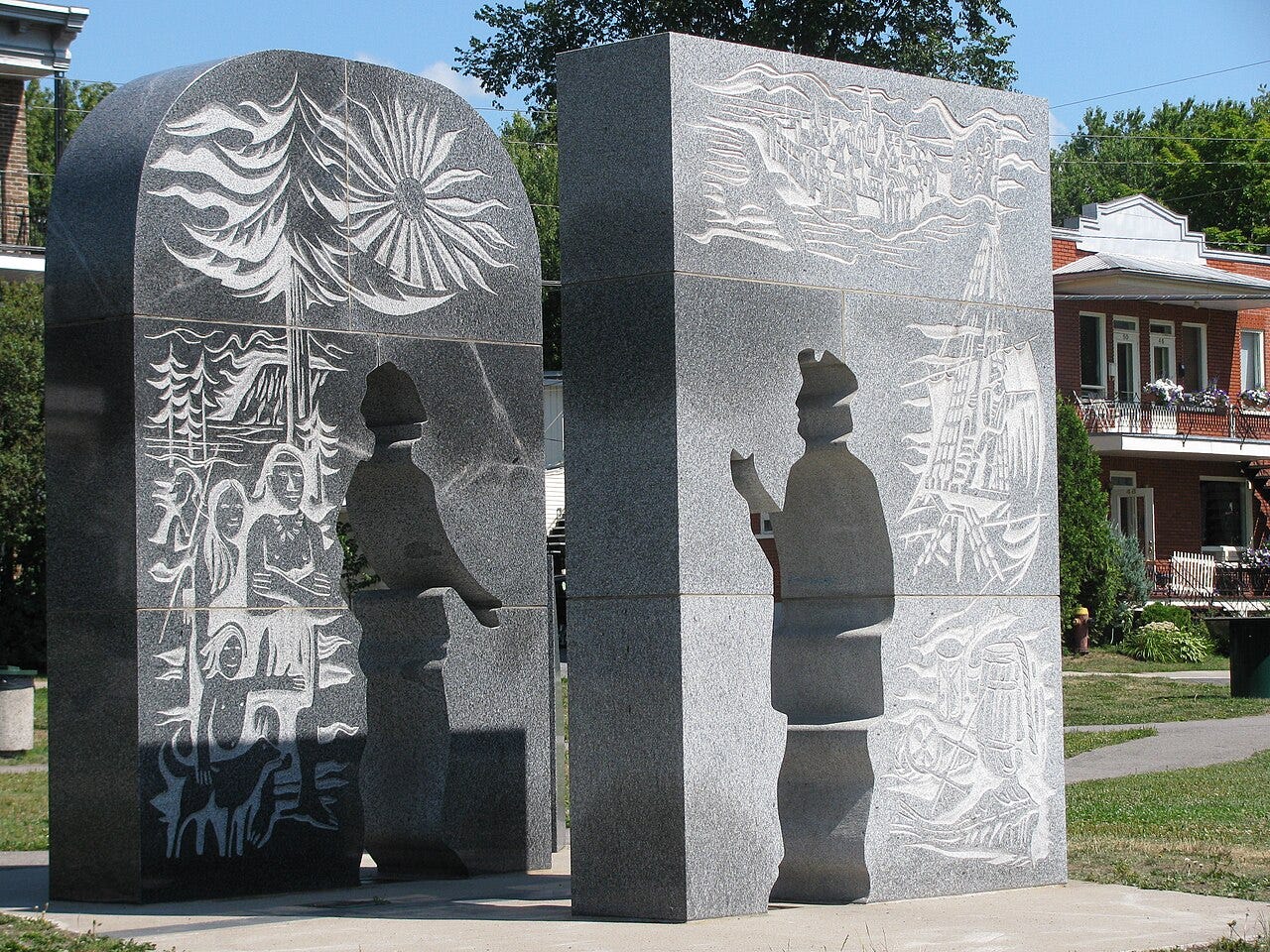
“A glorious era lies before us: we are entering Confederation. Let it not frighten you. After all, it is nothing but the realization of a plan designed by the first European to set foot in Canada, Jacques Cartier… With Confederation, we will realize a vision of this great man: the coming together of all of the provinces he discovered. If he rose from the grave today, he would undoubtedly look with satisfaction on this great country, enlightened by civilization, and soon to enjoy an era of prosperity and happiness…”
George Étienne Cartier, Montreal 1866.1
On July 1, 1867, the British North America Act received royal proclamation. The lands discovered by Jacques Cartier became a country.
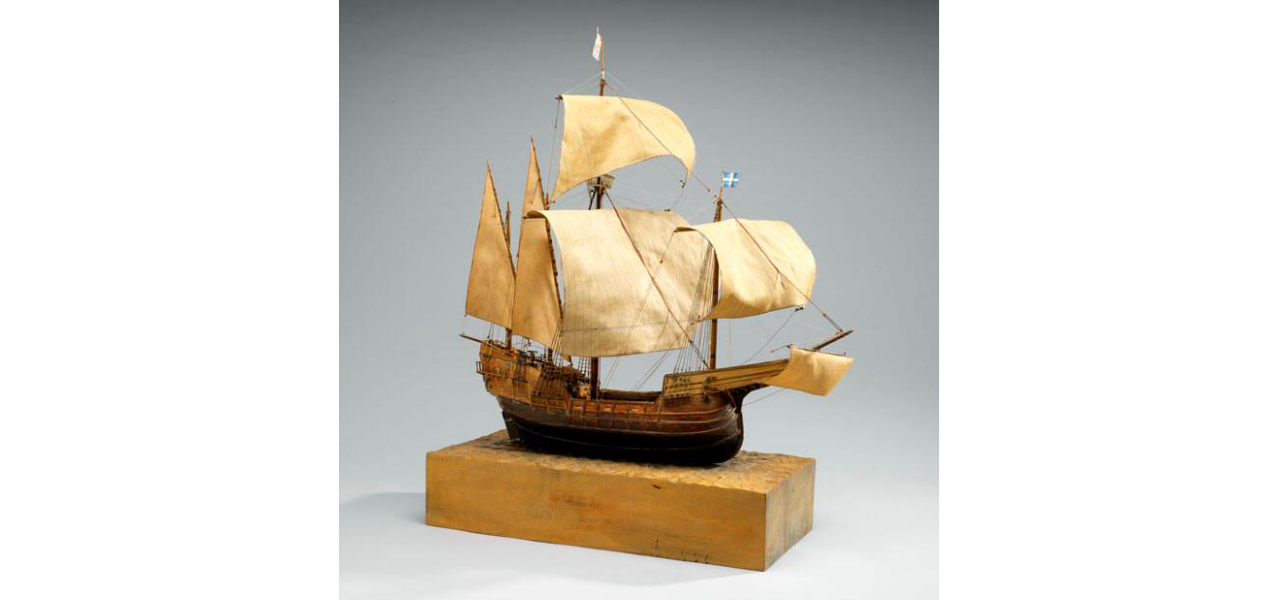
In the age of air travel, it’s hard for us to have a sense of what it would have been like to cross the ocean in Jaques Cartier’s time. Back in the 1500s, if everything went according to plan, one could look forward to months at sea, and adding onto the extreme boredom—gruelling physical labour, miserable weather, and your fellow passengers consisting of mostly rowdy and disagreeable men.
At night, if your crewmates finally quieted down for a few minutes, you would fall asleep to the crashing seas, and the creaking wood holding the ship together; the only thing between you and the endless, pitch black waves.
In these moments, we can glimpse the liminal states in which these explorers lived. Out in the middle of the unknown, between waking and dreaming, living and dying, pushing the limits of the world. With a still largely unknown land of beauty and danger waiting at the end of their journey.
New Kingdoms
On Cartier’s second trip to Canada, having made it across the ocean in one piece, he then traveled over 1500 kilometers through the St. Lawrence Valley. The open sea gave way to the life-giving, vivifying rivers of the interior. Still treacherous at times, these seemingly endless passageways presented new lands, peoples, and possible riches.
Previously we discussed how Cartier was guided by Chief Donnacona’s sons, who had returned with him from Europe after learning to speak French. And so began a long interplay of intepretation, translation, and inter-cultural communication between Europeans and the Indigenous in Canada.
In 1535, with the St. Lawrence River frozen, Cartier and his men stayed near Donnacona and his people for their first Canadian winter. They were unprepared in the small fort they constructed near the village of Stadacona (present day Quebec City). As the days became colder and shorter, nearly all of the French sailors began showing symptoms of an alarming and strange disease:
“The sickness broke out among us accompanied by most marvellous and extraordinary symptoms; for some lost all their strength, their legs became swollen and inflamed, while the sinews contracted and turned as black as coal. In other cases the legs were found blotched with purple-coloured blood. Then the disease would mount to the hips, thighs, shoulders, arms and neck. And all had their mouths so tainted, that the gums rotted away down to the roots of the teeth, which nearly all fell out. The disease spread among the three ships to such an extent, that in the middle of February [1536], of the 110 men forming our company, there were not ten in good health so that no one could aid the other.”2
Donnacona and his people served as guide to Cartier and his men once again. Now they offered miraculous, life-saving remedies to this startling disease. They taught the Frenchmen how to make a tea to cure themselves:
They showed us how to grind the bark and the leaves and to boil the whole in water. Of this one should drink every two days, and place the dregs on the legs where they were swollen and affected. According to them this tree cured every kind of disease. They call it in their language Annedda.3


The tea brewed from the trees contained enough vitamin C to quickly bring Cartier and his crew back from the brink of death after a terrible scurvy outbreak. In all, 25 still died that winter.
At the same time, around 50 Indigenous died from diseases the French had brought with them. The Europeans had no cures of their own to help them.
Donnacona kept Cartier’s spirits up, by telling him stories about a place called the Kingdom of Saguenay, to the north of the St. Lawrence, not far from the mouth of the Ottawa River.4 And Donnacona had also learned certain metals were highly valued to Europeans. As one historian put it, “either by deliberate misinformation or through a misunderstanding, Cartier became convinced of the mineral riches of the country.”5
Donnacona did his best to paint an enticing fantastical picture of this mysterious land, “where there are immense quantities of gold, rubies and other rich things, and that the men there are white as in France and go clothed in woolens.”6
As the weather improved, Cartier didn’t want to return to France empty handed. It was unfortunate for Donnacona that he was such a good storyteller. Because Cartier wanted the chief to come and tell the King of France about it all. He decided to strong arm Donnacona to come to France.
Cartier was able to coax the chief onto one of the French ships, leading him to believe they would discuss plans to abduct a rival of the chief’s son. But as soon as Donnacona came on board, Cartier’s men seized him. Holding Donnacona captive, Cartier made a promise to the chief and his people that Donnacona would return in no less than 12 moons (months).
It would be the last time they saw him.
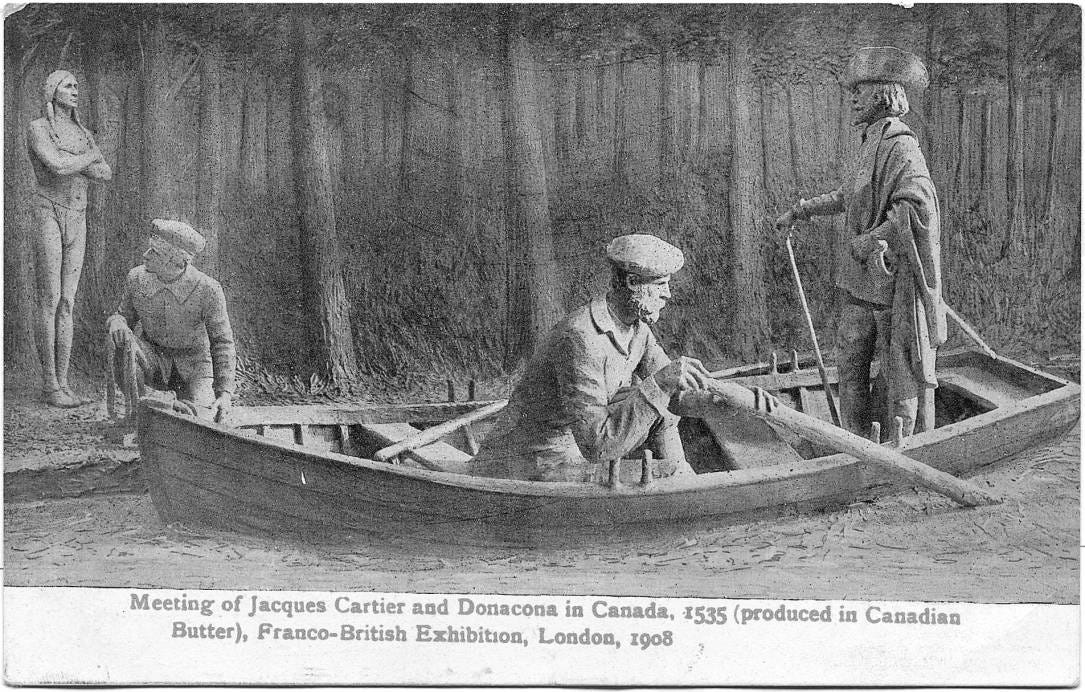
One historian sums up Donnacona’s ordeal after being taken captive:
Cartier abducted ten Stadaconans, including Donnacona, Taignoagny, and Domagaya, [Donnacona’s sons who guided Cartier] and whisked them to Europe despite the wailing and crying of the victims and their families… Donnacona visited the court of François I where he converted to Christianity, received an annual pension, and spent four glorious years spreading the lore of the Kingdom of the Saguenay… By the time Cartier began preparations for another voyage across the Atlantic, all but one of the Stadaconans in France had died… Donnacona, at least, was given a Christian burial.7
The Iroquoian chief must have experienced a whirlwind of misery, curiosity, homesickness, and awe. Donnacona originally entered into an alliance with Cartier in hopes of using French firepower against his rivals. Like the French sailors who braved the seas only to succomb to a horrible unknown disease, these meetings between worlds could result in riches, fortune, and fame—as well as tragic deaths in strange lands.
The Conquest of Saguenay
In 1541, Cartier made his third and final voyage to Canada. It had the makings of a failure from the start. Cartier was no longer in charge of the mission. He had lost favour at court after his failures thus far to bring back the treaures found by the Spanish or Portugese in the southern regions of the Americas.
Jean-François Roberval was appointed to lead the expedition. Roberval was a good friend of the king and seasoned veteran of war in Europe. He was tasked with settling a French colony along the great river discovered by Cartier, and to find the Kingdom of Saguenay. The King and his advisors had put their trust in Cartier and Donnacona’s tales.
The expedition’s mission objectives were to: “found a colony, begin missionary work, and effect the conquest of Saguenay [and] unlike the previous voyages, this one was organized like those of the Spanish conquistadores and included 300 soldiers as well as cannons.”8


One historian casts serious doubt on Cartier’s judgement, “the sheer incompetence of Cartier is breathtaking. After two previous voyages to Canada, how could he have thought of moving an army and siege cannons through the rugged, heavily forested lakes and river system of the Laurentian Shield, north of the St. Lawrence River?”9
Cartier clearly remained determined to get a taste of the riches explorers had won in places like Mexico and Peru. So he sailed up past Stadacona, to the Cap-Rouge River on the north shore of the St. Lawrence.
Cartier’s men constructed a new, larger settlement of some 400 people, and named it Charlesbourg-Royal, after the king’s third son. It was a short-lived, disastrous first attempt at building a lasting settlement in Canada:
During his stay, [Cartier] was plagued by increasingly deteriorating Native relations and a severe winter. Basque fishermen, who came in contact with some St. Lawrence Iroquoians in the Gulf of St. Lawrence late in 1542, claimed that in open fighting with Cartier’s men the Natives had killed 35 of them.10
With Donnacona never returning from France, Cartier had little sway with the Indigenous of the area—his word didn’t mean much. The new larger settlement also encroached on their territory.
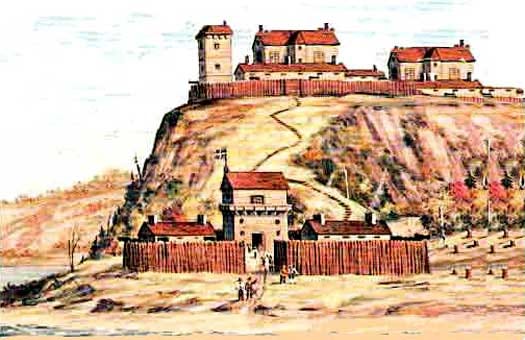
Surveying the situation, Cartier simply decided to cut his losses after one year at the new settlement. He bundled up as many as the mineral riches he had come for and planned to skip town as soon as the river thawed.
Roberval came loaded with new provisions and colonists just as Cartier was trying to sneak away. He ordered Cartier and his men to return to the settlement. Cartier initially seemed to fall in line. But as soon as Roberval let his guard down, Cartier slipped away in the night with his crew, eventually making their way back to France.11
Roberval attempted to salvage what he could. He was a soldier and he had his orders. Roberval expanded the settlement, using his expertise in building fortifications in war. He was also able to use some diplomacy skills, and calmed relations between the region’s Indigenous inhabitants and the remaining colonists.
Roberval expected to reach Saguenay, affect its conquest and to return all in the short space of three weeks.12 The first attempt was cut short due to a capsized boat which left eight men drowned. Other business of the struggling settlement took priority, and trips to find Saguenay were put on hold.
Soon enough, the weather turned and Roberval and his men again encountered a terribly harsh winter, losing dozens of men to scurvy just as Cartier had. By 1543, they had enough. Luckily, ships from France arrived with the welcome news that Roberval was expected back in Europe; France and Spain were at war again. The fort and settlement were abandoned, and Roberval took his men, along with treasures similar to those Cartier had found, and set off for France.
The World Keeps Turning
In 1543, the same year the first permanent French settlement in Canada was abandoned, astronomer and polymath Nicolaus Copernicus published his landmark work, De revolutionibus orbium coelestium (On the Heavenly Spheres).
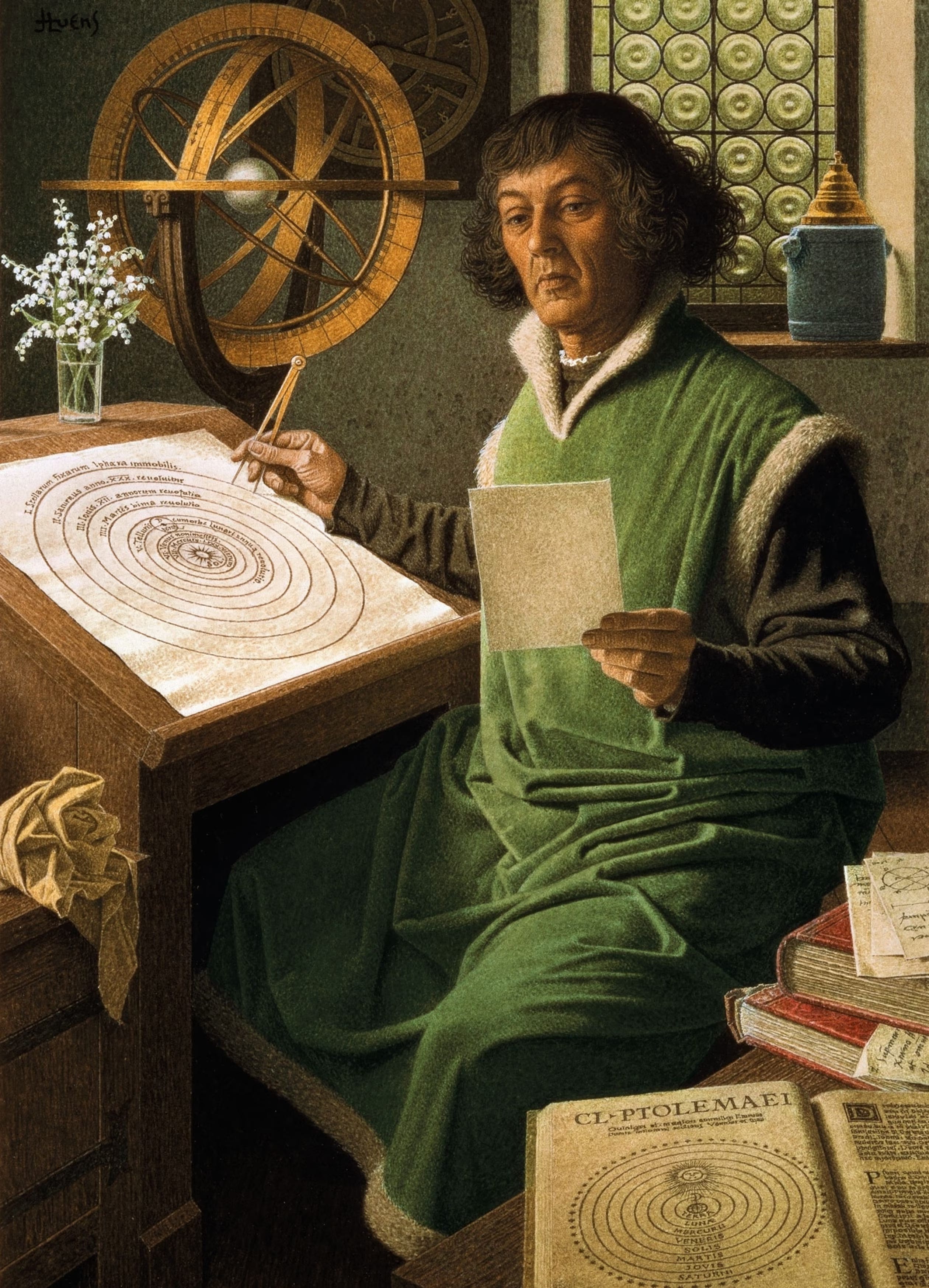
We’ve previously discussed how the Renaissance ‘rediscovered’ man, and new technologies such as mapmaking and shipbuilding allowed explorers to travel further than before.
Copernicus’ heliocentric model placed the sun at the centre of creation, rather than the earth—further mapping the world.
For our purposes, we can understand this change as a new technology itself, producing a worldview in which man is no longer at the centre. This break away from the traditional ways of looking at reality had several consequences.
By adopting an increasingly mechanical view of things, European man would gain great material powers over his environment. The Scientific Revolution would accelerate technological progress—leading to material prosperity and breakthroughs across several domains. Change became the norm, and participation in the world required one to be a bit more liminal.
Amidst this reorienation of man’s place among the stars, it was clear that Canada was far from the centre of any European’s world. As it turned out, Cartier hadn’t fared much better than Roberval in getting out of Canada when he did. The gold and diamonds the two of them had managed to scrounge up were actually worthless quartz crystals and iron pyrite.

Through explorer’s eyes, these northern lands first appeared an enticing prize. But efforts to settle or take hold proved too dangerous, too cold. For the time being, Canada looked like Fool’s Gold.
Next:
French explorers would not return to Canada for another 60 years after Cartier and Roberval abandoned Charlesbourg-Royal. Then in 1603, Samuel de Champlain set sail.
Dennis Gruending, Great Canadian Speeches (Markham, ON: Fitzhenry & Whiteside, 2004), 45.
H. P. Biggar, The Voyages of Jacques Cartier: Published from the Originals with Translations, Notes and Appendices, Publications of the Public Archives of Canada No. 11 (Ottawa: F. A. Acland, 1924), 205.
This paper delves into the science and possible exact tree used by Donnacona’s people to help treat Cartier’s men for scurvy. https://pmc.ncbi.nlm.nih.gov/articles/PMC2647905/
Biggar, Voyages of Jacques Cartier, 270.
Alan Gordon, The Hero and the Historians: Historiography and the Uses of Jacques Cartier (Vancouver: UBC Press, 2010), 18.
Biggar, Voyages of Jacques Cartier, 221.
Ibid., 21.
Samuel de Champlain before 1604: Des Sauvages and Other Documents Related to the Period, ed. Conrad E. Heidenreich and K. Janet Ritch (Toronto: Champlain Society, 2010), 43.
Ibid., 145.
Ibid., 44.
Biggar, Voyages of Jacques Cartier, 265.
Ibid., 270.