

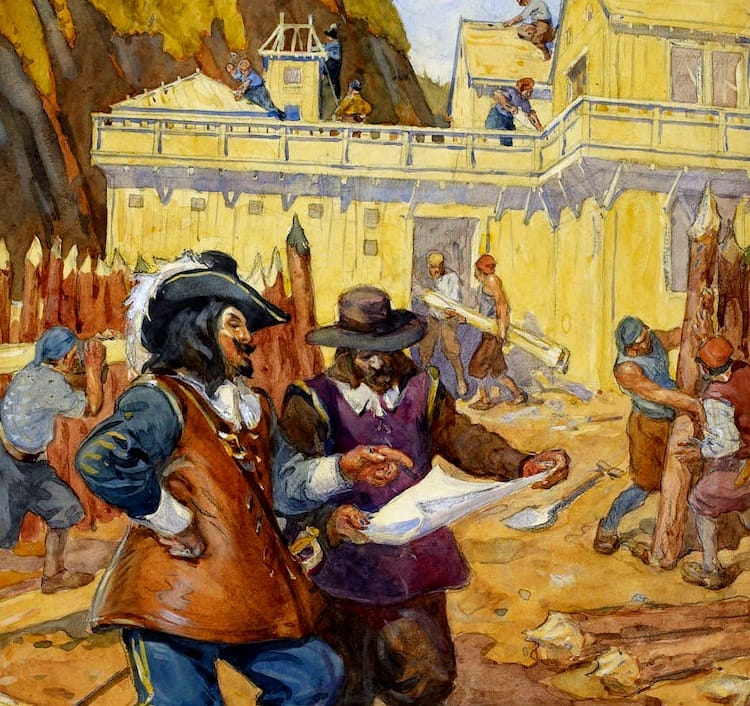
Since his first trip to Canada, Samuel de Champlain had a pretty good idea that if the French were going to plant an enduring settlement, it would be along the St. Lawrence River.
Since the first Frenchmen sailed down its shores, it was apparent that here laid the grand entry into a new world. As Jacques Cartier had written to King François I, “the richness of the great river, which flows through and waters the midst of these lands of yours, is without comparison the largest river that is known to have ever been seen.”1 Most Indigenous groups of the area had long characterized it in similar terms—designating it simply as the “Great River” or “Big Waterway”.2
The river served essential economic purposes as a highway for people and resources, but it also molded the identities of its inhabitants. The St. Lawrence functioned as a fertile ground, vivifying and life-giving. Other times, when winter rolled in, it served as an intermediary chaotic structure, as it froze and cut off those who lived on its shores from contact with the ocean.
There were several practical reasons to favour the St. Lawrence for establishing a colony. The most economically obvious was the proximity to the already well-oiled and functioning fur trade—with Tadoussac, on the north shore of the estuary of the St. Lawrence, being the final stop on major routes.3
Another factor for the French was the aim of beating their European rivals to the punch. The English and Dutch were not slowing down their territorial claims down the northeastern coasts of the continent. Also, if the long sought-after sea route to Asia was still waiting to be found, if would only be discovered through continued exploration into the interior, from established bases inland.
So in 1608, Champlain returned to this grand gateway to Canada, and established a settlement which would persist for the next four hundred years.
Arrival
Sailing up the great river, the explorer assessed his surroundings. At the Île d’Orléans, about five kilometres east of present-day downtown Quebec City, he remarked, “all this coast, both on the north and south sides, from Tadoussac to the island of Orleans, is hilly country, and very poor, with nothing but pine, spruce and birch, and very ugly rock.”4
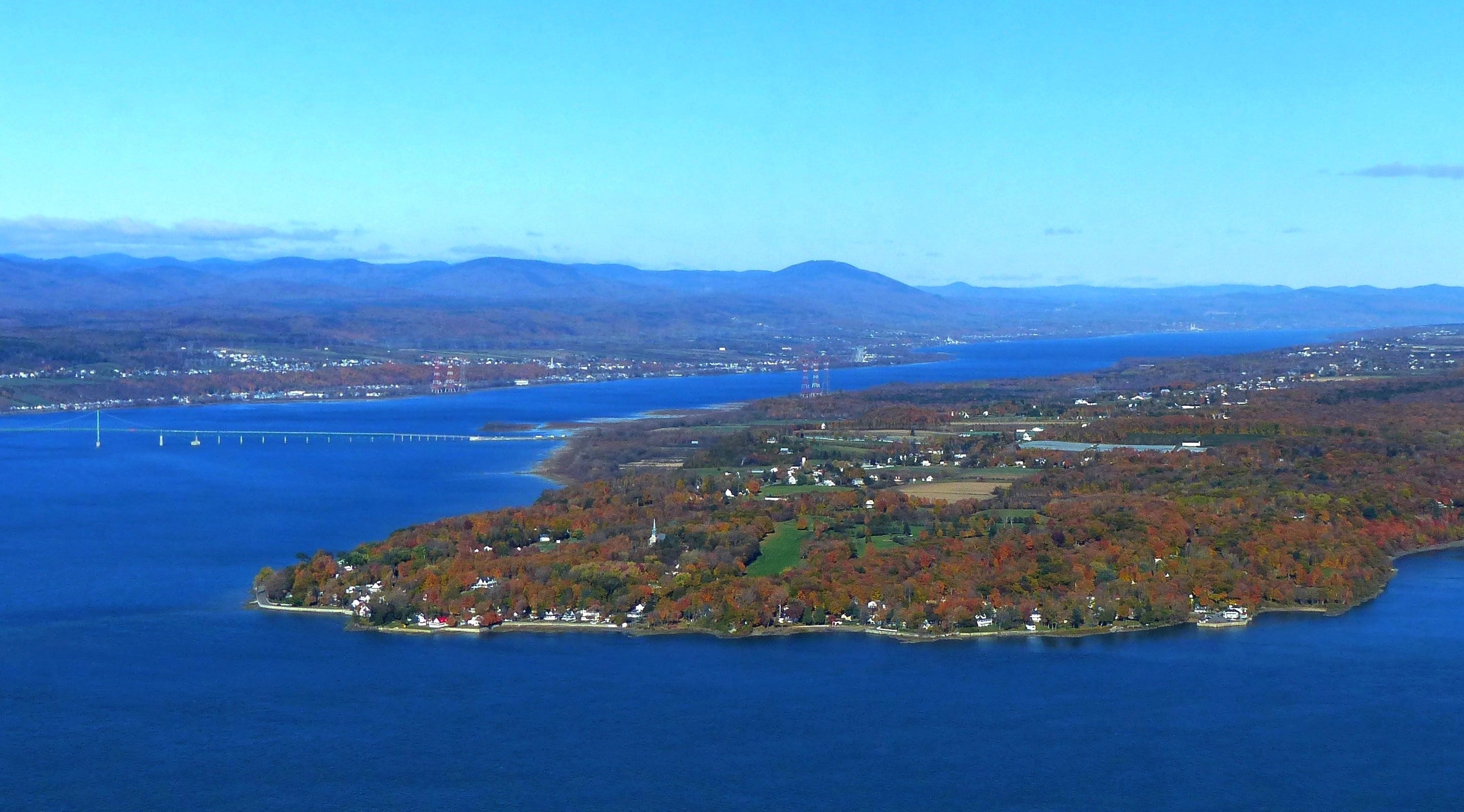
Continuing on, “from the island of Orleans to Quebec is one league, and I arrived there on July the third. On arrival I looked for a place suitable for our settlement, but I could not find any more suitable or better situated than the point of Quebec, so called by the natives, which was covered with nut-trees.”5
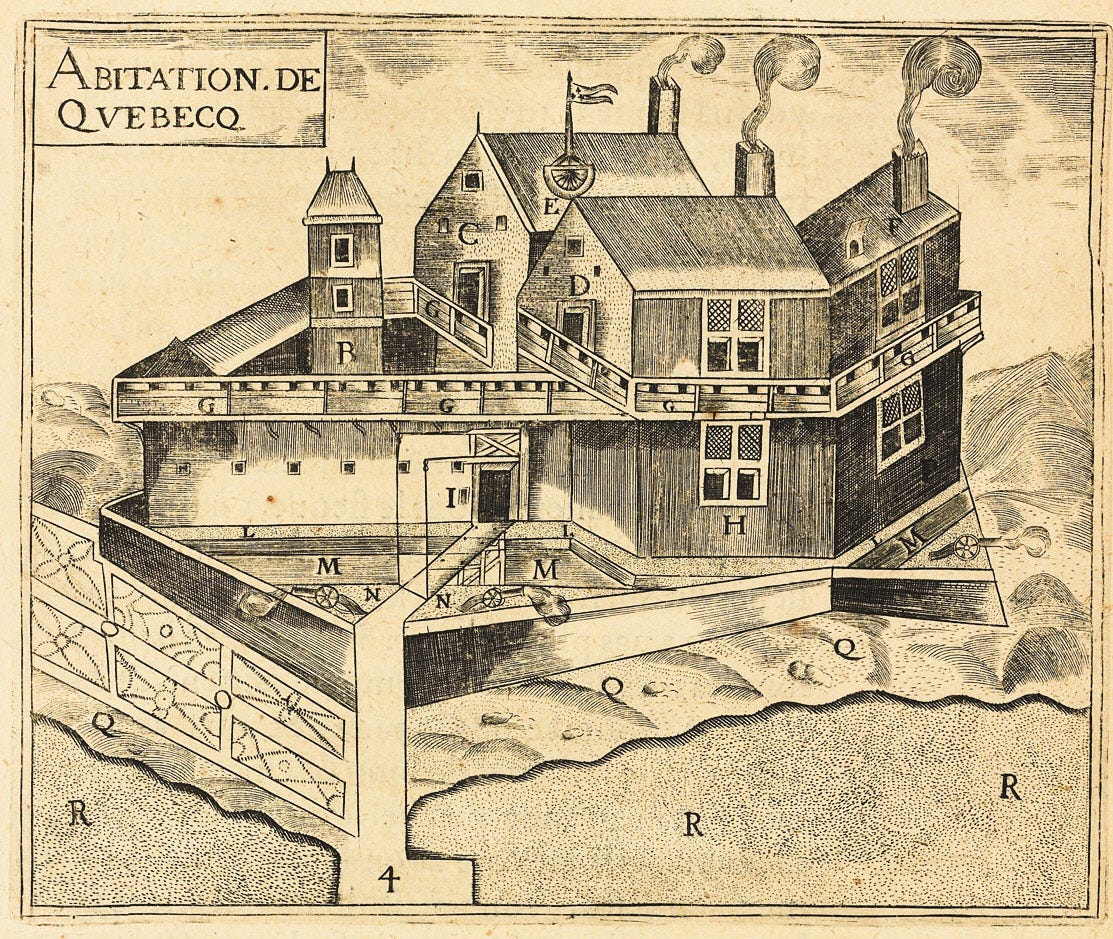
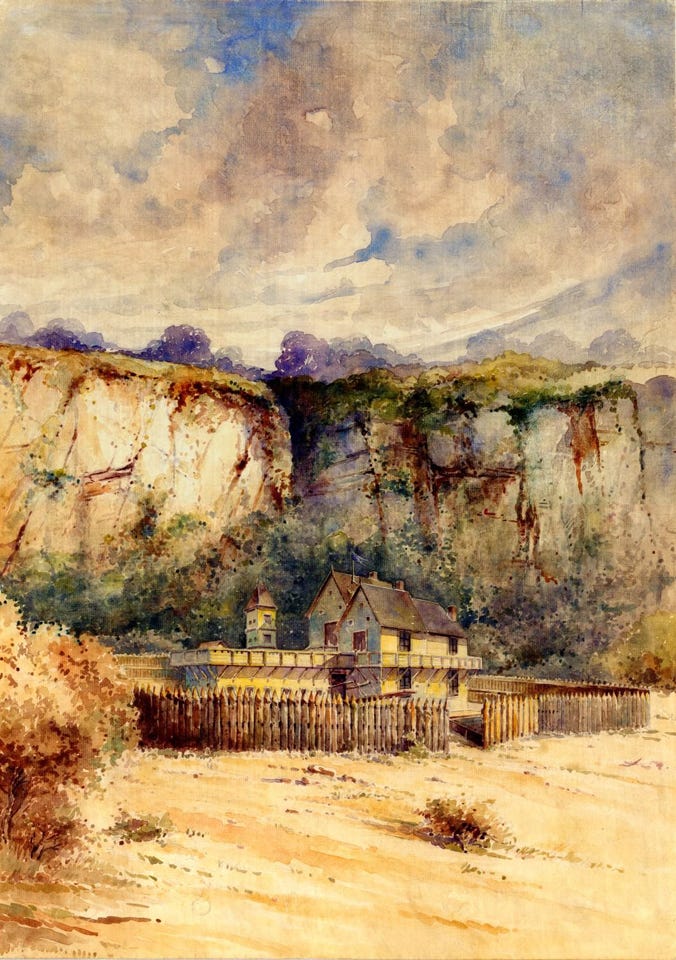
Champlain quickly put his men to work in this area, constructing what he began referring to as the Abitation de Québecq. For many years, the initial structures would function as little more than a fortified post along the fur trading route.
Three buildings were constructed on the banks of the river, all connected by a second-floor gallery, with a moat and drawbridge, and palisade around the exterior. It was a little less friendly to the outside world than the arrangement in Acadia, which invited in their Indigenous upper-class neighbors over to eat and drink. As one historian remarked, “here at Quebec in 1608 was a reproduction in miniature of a European fortress.”6
Unfortunately, the first few Canadian winters brought much suffering for the ordinary workmen who built Quebec. Out of the original 28 men who arrived in September 1608, no more than eight remained by May 1609.7 Scurvy, the familiar, terrible disease, struck again. That same winter was devastating for the Indigenous people of the area as well.
On one occasion, Champlain recalled a group of them appearing out of the trees, risking death crossing an icy river to reach the French settlement, “so thin and emaciated that they looked like skeletons”. The French gave them provisions of bread and beans, and in their hunger these poor souls also resorted to eating half-cooked fox and dog carcasses which the French used to attract game outside of the habitation.8
Vivid examples like these exposed the early French colonists to the immediacy of danger in Canada. Beauty and awe was often correlated with cold and death. And sometimes the clothing that you used in Canada to extend yourself into this majestic, scary world simply wasn’t enough to survive.
Along the St. Lawrence, the French confronted a land filled with potential and quantity. And as we’ve seen, their attempts to colonization were slow to develop compared to other European efforts in the Americas. They had to carefully implement systems of order if they hoped to have success.
To bring stability to new settlements along the St. Lawrence, the colony would be filled with localized, miniature markers and signs of its mother country. A heightened adherence to social norms and customs would also be required. Time would tell if this approach could plant the seeds of a new society.
Trouble in Paradise
Some of the first colonists in Quebec quickly decided that they were not terribly interested in seeing through a plan measured by centuries. Instead, they decided to try and make a quick buck. And just as quickly as Quebec was founded, some of Champlain’s own men turned on him.
A small group had conspired to cash in on a deal struck with Basque fur traders based down the river at the Tadoussac trading post. The mutineers agreed to take out Champlain and deliver control of the Quebec habitation to these traders for a cash reward.
Luckily, one of the would-be conspirators of the plot came forward and confessed before the plan could be carried out. Champlain granted a pardon to the man who confessed, and had the rest of the group arrested.
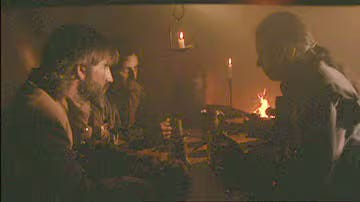
Champlain administered a sentence of death upon the ringleader, a locksmith named Jean Duval; and his three accomplices. Duval had been in Champlain’s crew since their stay at Port-Royal in Acadia. Duval was nearly killed by an arrow through his chest during one of Champlain’s explorations in the Cape Cod area years prior. Marc Lescarbot, the first-hand historian of New France, later remarked of Duval’s fate, “better would it have been for him to die [back then]”.9
Champlain recalls the events of this attempted mutiny very matter-of-factly, and does not waver in instilling order. He succinctly explains his reasoning behind the verdict:
We decided that it would be sufficient to put to death Duval as the first mover in the conspiracy, and also to serve as an example to those who remained, to behave properly in future in doing their duty, and in order that the Spaniards and Basques who were numerous in the region might not rejoice over the affair… Duval was hanged and strangled at Quebec, and his head placed on the end of a pike and set up in the highest spot in our fort, and the other three were sent back to France.10
Canada seemed to have an effect of pushing people to their limits, and making them do things that could be extraordinarily brave and daring, as well as reckless and foolish.
But Champlain was finding a middle ground in this new world, somewhere between an unabashed and open embrace of the environment, which came naturally as an explorer, and a cool ability to instill discipline and order in a chaotic space, which he learned as a soldier. New France needed more of the latter.
The stakes were getting higher. Champlain had been lucky and used his skills well so far, but who know how many more chances he would get. It was clear that in Quebec, there would initially be much less of the merry atmosphere surrounding the Order of Good Cheer in Acadia.
In these early years, in addition to occasionally mutinous locksmiths like Duval, the habitation relied heavily on various tradesmen, such as plank sawyers, carpenters, masons, stonecutters, sailors, surgeons, gardeners, farmers, and lumberjacks.11
Champlain: Soldier & Diplomat
As the small settlement of Quebec slowly grew, Champlain went to work to fulfill the promise made back in France to aid their new Indigenous allies in war. Along with only a few other Frenchmen, Champlain accompanied hundreds of Huron (Wendat), Montagnais, and Algonquin warriors, into enemy territory against their Iroquois (Mohawk) rivals.
After finding success using Indigenous birchbark canoes, it was Champlain’s turn to return the favour and engage in technological exchange. He came armed with an early form of musket called an arquebus. When compared to skilled archers, the typical arquebusier in France was a clunky soldier—very slow to reload, and not terribly accurate or effective at long range.12 But, the weapon and man who fired it could be effective in battle against those who were unacquainted with the technology.
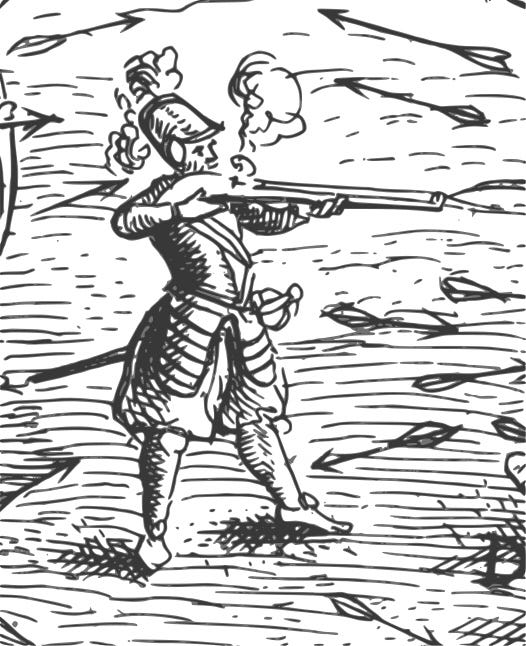
In 1609, Champlain became perhaps the first European to join a battle between two North American Indigenous armies.13
David Hackett Fischer paints a picture of the psychological impact of Champlain’s technological clothing as the battle began:
Champlain’s burnished steel cuirass and helmet glittered in the golden light of the morning sun. The Mohawk stopped in amazement and studied this astonishing figure who had suddenly appeared before them, as if he had risen out of the ground… There was a mighty crash and cloud of white smoke. Two Mohawk chiefs fell dead, and another warrior was mortally wounded—three men brought down by one shot. Champlain’s Indian allies raised a great shout, so loud that “one could not have heard the thunder”.14
The outcome of this particular battle scored a key strategic victory. But far more importantly, Champlain’s foreign technology also uprooted war as the Indigenous knew it. Fischer notes that it was a “pivotal event in the history of Indian warfare… [they had] fought in close formation. In the face of a new reality, the Indians learned quickly, and changed to what would later be called a “skulking way of war.”15
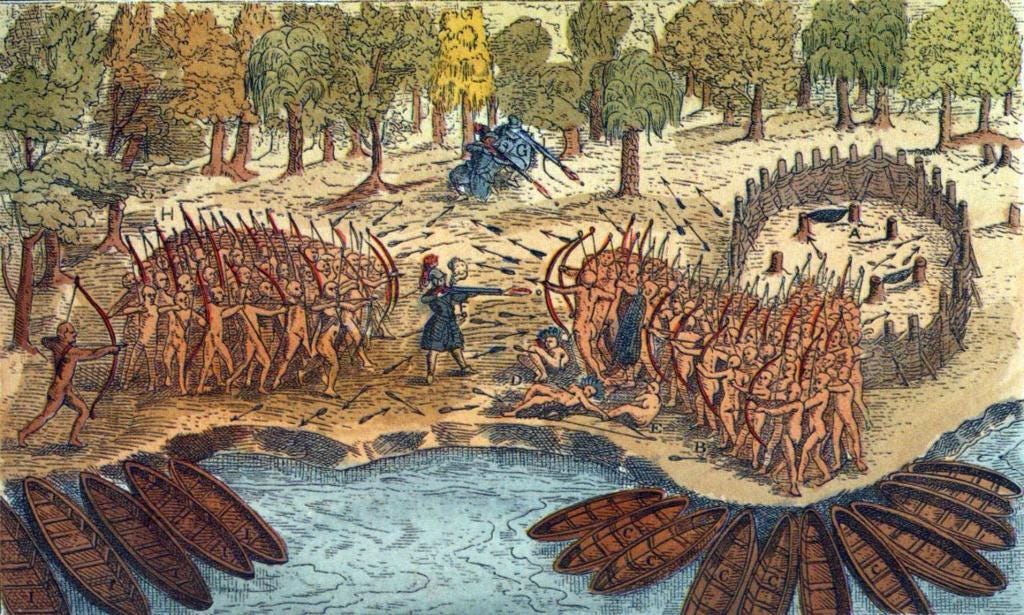
Champlain had also fired the first shot in a series conflicts between the French and the Iroquois, which would last into the next century.
At the time, it seemed like everything was coming together for Champlain. His experience as a soldier gave a coolness and proficiency to establish himself as a competent leader, administering justice and leading in battle.
He avoided the mistakes of his predecessors and established strong alliances with the Indigenous of the area. And his philosophy based on toleration and cultural exchange was bearing fruit. Best of all, he was free again to continue what he loved most—exploring the beauty of God’s creation.
And then, he received the terrible news: the king was dead.
King Henri IV had survived several attempts on his life. Not everyone in France had been as enthusiastic as Champlain in accepting the convert king’s ideals of toleration. And some were still terribly bitter about conclusion to the long and destructive Wars of Religion.
In 1610, as the king’s carriage rolled to a stop amidst heavy Paris traffic, François Ravaillac, a Catholic schoolmaster described by one historian as a “religious fanatic and academic lunatic”16, suddenly climbed into the royal coach and plunged a knife into King Henri’s chest.
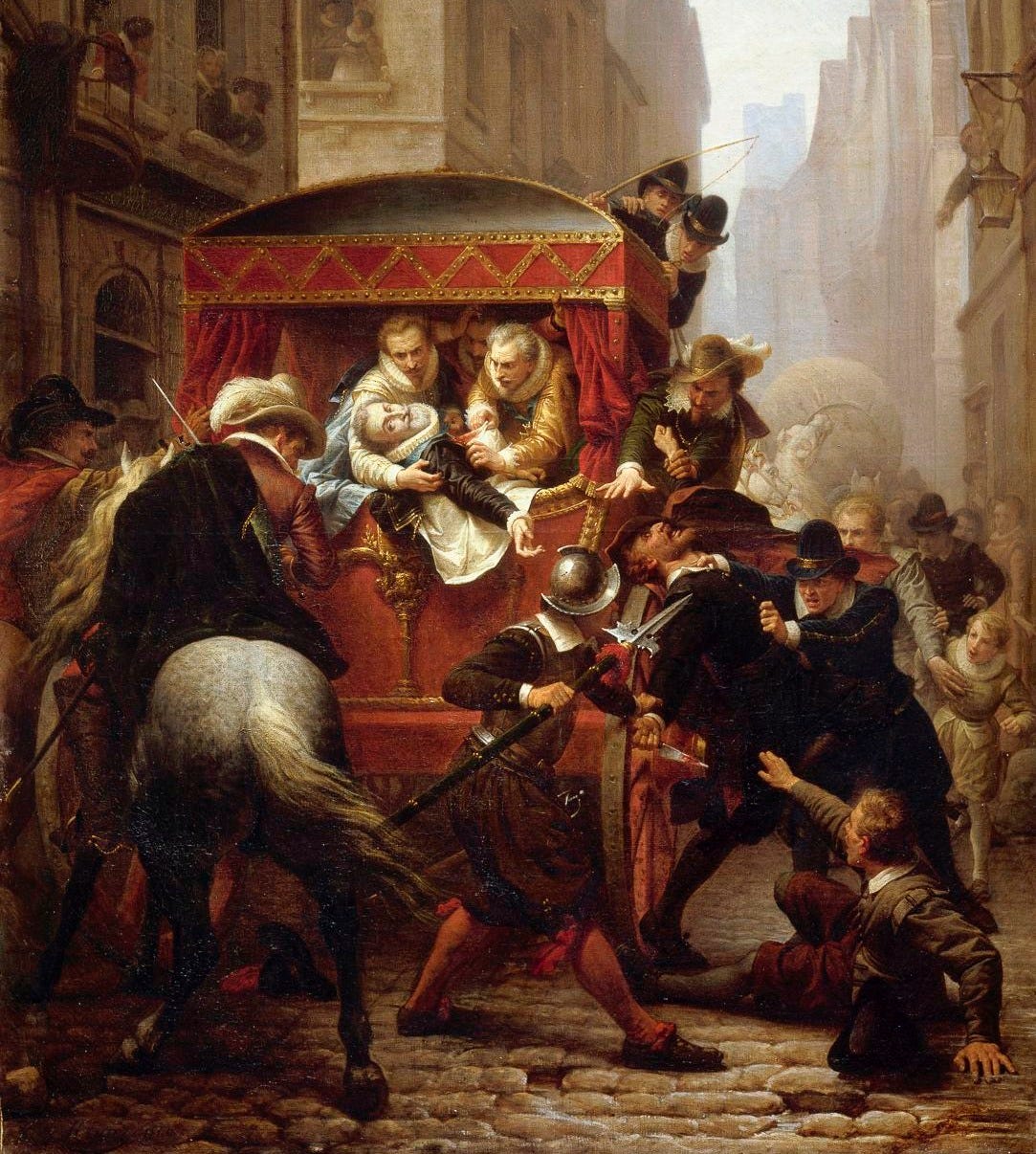
In an instant, not only had Champlain lost his king, but someone he genuinely looked up to and respected dearly. It was their shared vision that set Champlain’s course to explore and settle in Canada. And now the entire endeavour was at risk of falling apart.
The heir to the throne, Louis XIII, was only a few months away from celebrating his ninth birthday when his father was killed. The king’s widow, the Italian Marie de’ Medici, was made Queen Regent, until her son came of age.
For the next several years, Champlain would have to periodically make the journey between worlds to return to Paris and ensure that the various schemers at court did not influence the young king or his mother to threaten his vision for New France and Canada.
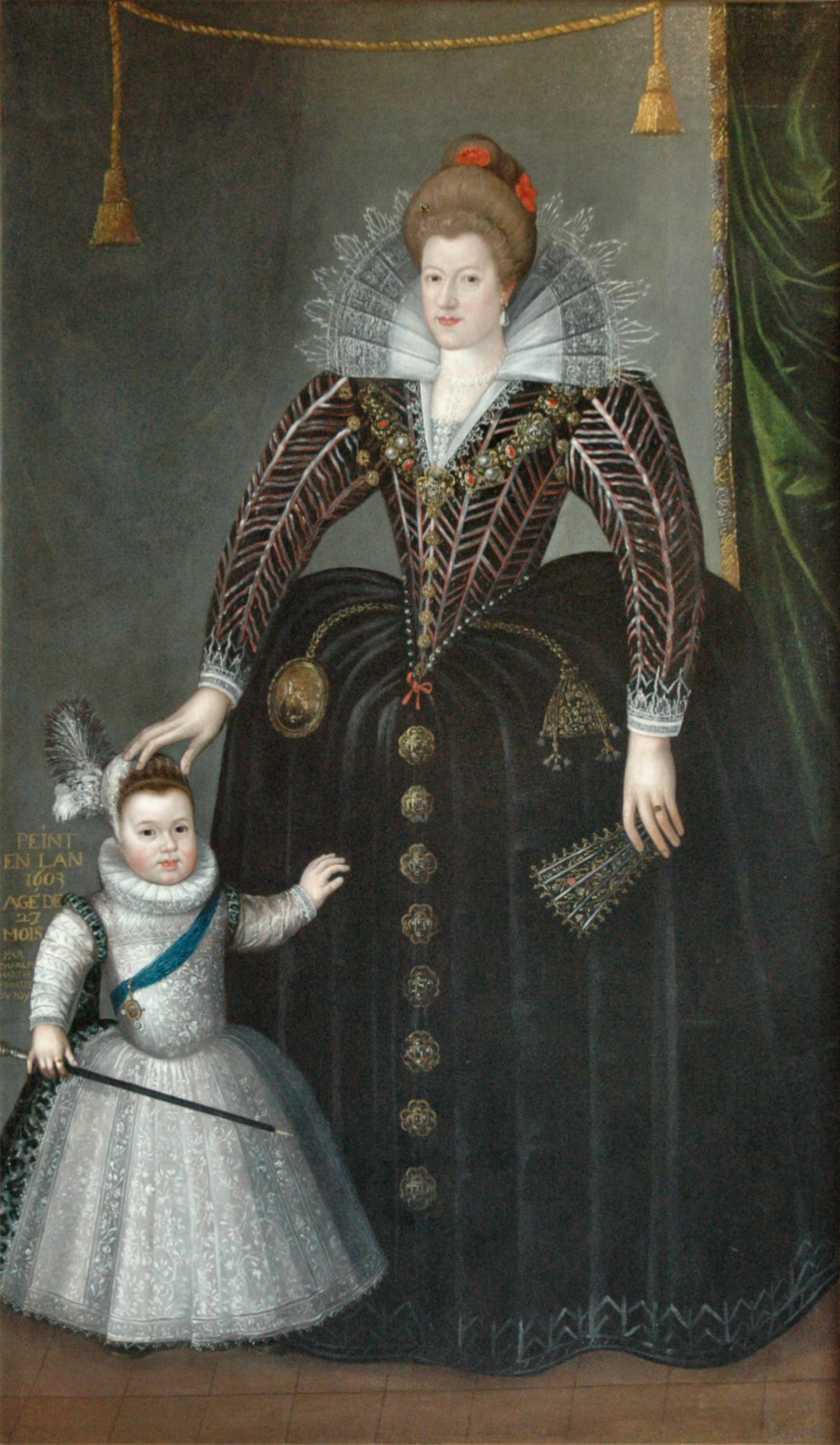
Fortunately, Champlain developed a knack for navigating in a complex world of politics and court dynamics. In 1613, his negotiations and insistence eventually led to the establishment of the Compagnie du Canada. The entire St. Lawrence was to become the “exclusive reserve”17 of this new organization.
But much to Champlain’s consternation, for the major players in the new company, growing New France with settlers was a secondary concern to maintaining and exploiting their monopoly over the fur trade. The company committed to establishing only six families in the colony over eleven years. As a result, it was not until 1619 that Quebec began to evolve from a simple post by the river and a storehouse for the company, into a full-fledged village.18
To secure continued funding, Champlain established relations with influential groups in the Church, and also, pious and wealthy members of the French aristocracy. With many potential benefactors, there were often struggles for power when dealing with these groups.
The Society of Jesus, the order commonly known as the Jesuits, were often at the centre of many of these disputes. The Jesuits were expelled by King Henri back in 1594, following an assassination attempt on the king by a Jesuit pupil. There was lingering animosity and feelings of disloyalty due to the order’s support of the Catholic League, who opposed the king and his army during the Wars of Religion.19
Throughout the 1600s, the Jesuits established themselves at the forefront of international missionary work throughout Asia and the Americas. And by 1603, the Jesuits were fully reinstated to operate in France, just in time to lend a hand with King Henri’s ideas of expansion and colonization. Henri also made a shrewd political choice by reversing course and promoting the Jesuits, drawing away some of these men who had been the King of Spain’s strongest missionaries.
But it would be Acadia rather than Quebec where evangelization would first take place. At Port-Royal, we see the beginnings of missionary work, in which attempts were made to re-make the church in the new world.
Societies of Jesus
In 1610, Jean de Poutrincourt, lieutenant of Pierre Dugua de Mons, returned to Acadia with a smattering of colonists and renewed funding. Poutrincourt didn’t like the Jesuits very much, finding them untrustworthy due to their Spanish and Popish sympathies. He refused to take any with him despite King Henri’s wishes. Instead, he chose his own priest, Father Fléché.
The French found their settlement at Port-Royal had been well taken care of. In their absence, the fearsome and respected M’ikmaq chief Membertou and his people had maintained the buildings and crops, and were glad to see their French companions again.
Poutrincourt had his priest quickly get to work. Fléché presided over the baptism of Membertou and 20 members of his family, as they became the first of their people to be baptized on their native soil. Between 1610 and 1611, over a hundred Indigenous baptisms were carried out in the area.20
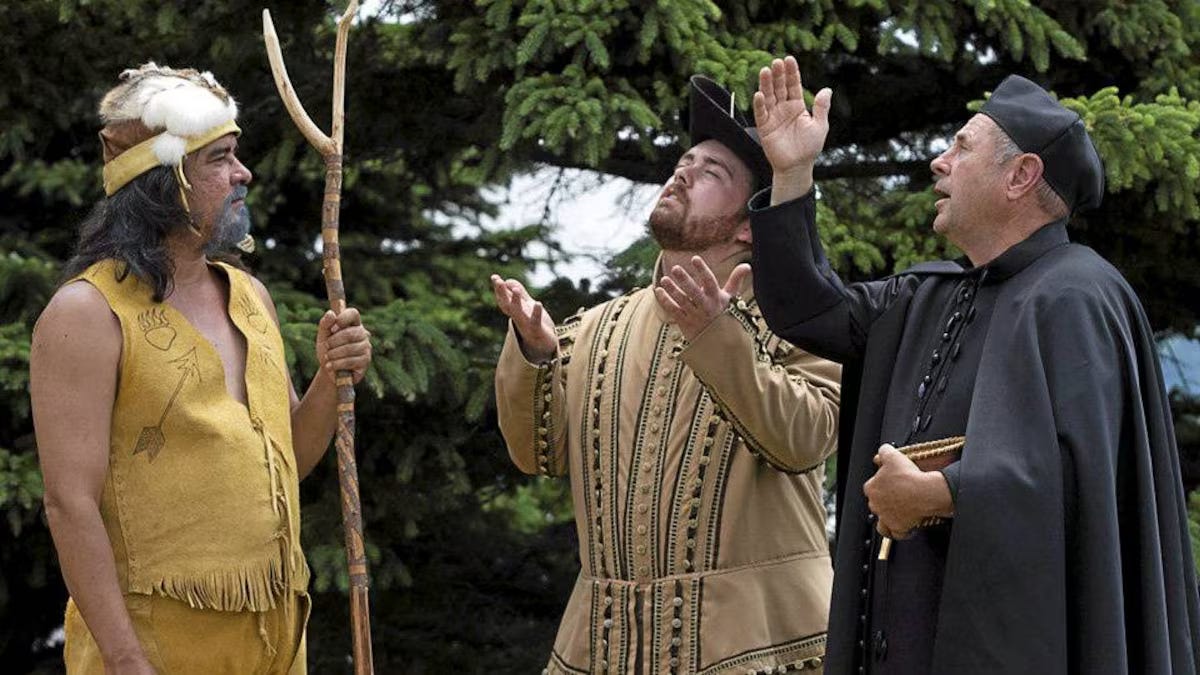
Poutrincourt made sure to popularize these successes back in Paris, to show that that the Jesuits weren’t needed in New France.
But the Jesuits were not easily deterred. They went straight to the Queen Regent and reminded her of the promise her late husband had made, and were soon granted permission to journey tp Acadia.21
Upon arriving at Port-Royal, it quickly became clear to the Jesuit Fathers Pierre Biard and Énemond Massé, that the methods employed by Father Fléché had produced less than stellar converts. The Jesuits reported their initial findings:
[The Indigenous near Port-Royal] accepted baptism as a sort of sacred pledge of friendship and alliance with the French. As regards Christ, the Church, the Faith and the Symbol, the commandments of God, prayer and the Sacraments, they knew almost nothing; nor did they know the sign of the cross or the very name of Christian. So, even now, whenever we ask any one, “Are you a Christian?” every one of them answers that he does not understand what we are asking him. But when we change the form of our question and ask, “Are you baptized?” he assents and declares himself to be already almost a Norman, for they call the French in general Normans.22
The Jesuits urged a different approach. Consisting of careful and sound instruction, and delay of adult baptisms until an understanding of the faith was sufficient. The Jesuits had additonal thoughts of how to better run the colony too. The newly arrived fathers frequently butted heads with the leaders of Port-Royal, including Poutrincourt’s son, Biencourt.23
Port-Royal was becoming a microcosm of the old world, but in all the wrong ways. Ideas of toleration and coexistence had been replaced with same dynamics that all-too-often plagued the royal court in the Louvre. The largely empty shores of eastern North America became another opportunity for bickering between Catholics and Protestants, and clergy and noblemen.
The Acadian story was far from over, but already multiple times the region showed the difficulties of trying to establish “home” in a new place. The often-popular view of colonial enterprises as being a top-down, all-encompassing display of power or exploitation over native inhabitants of far-away lands was often much more complicated.
Throughout New France, it was a continual negotiation for competing groups to establish a microcosm of the world they had known. The explorers, colonists, missionaries, and labourers all had roles to play in the quest to win souls for Christ, expand the influence and power of France, and bring Canada into being.
By 1615, the first missionaries arrived in Quebec. Again they were not Jesuits, but four Récollet priests, part of a reformed branch of the Franciscan order, recruited by Champlain.24
Champlain was determined to not follow the approach of the English or Dutch in settling away from the Indigenous groups of which they came into contact. He wanted to maintain a steady flow of cultural exchange. The Récollet fathers were brought to support both the French settlers as well as their Indigenous counterparts.
Champlain set his men at to work at Quebec, to clear land and build lodging for the fathers, and construct a chapel to celebrate mass.25
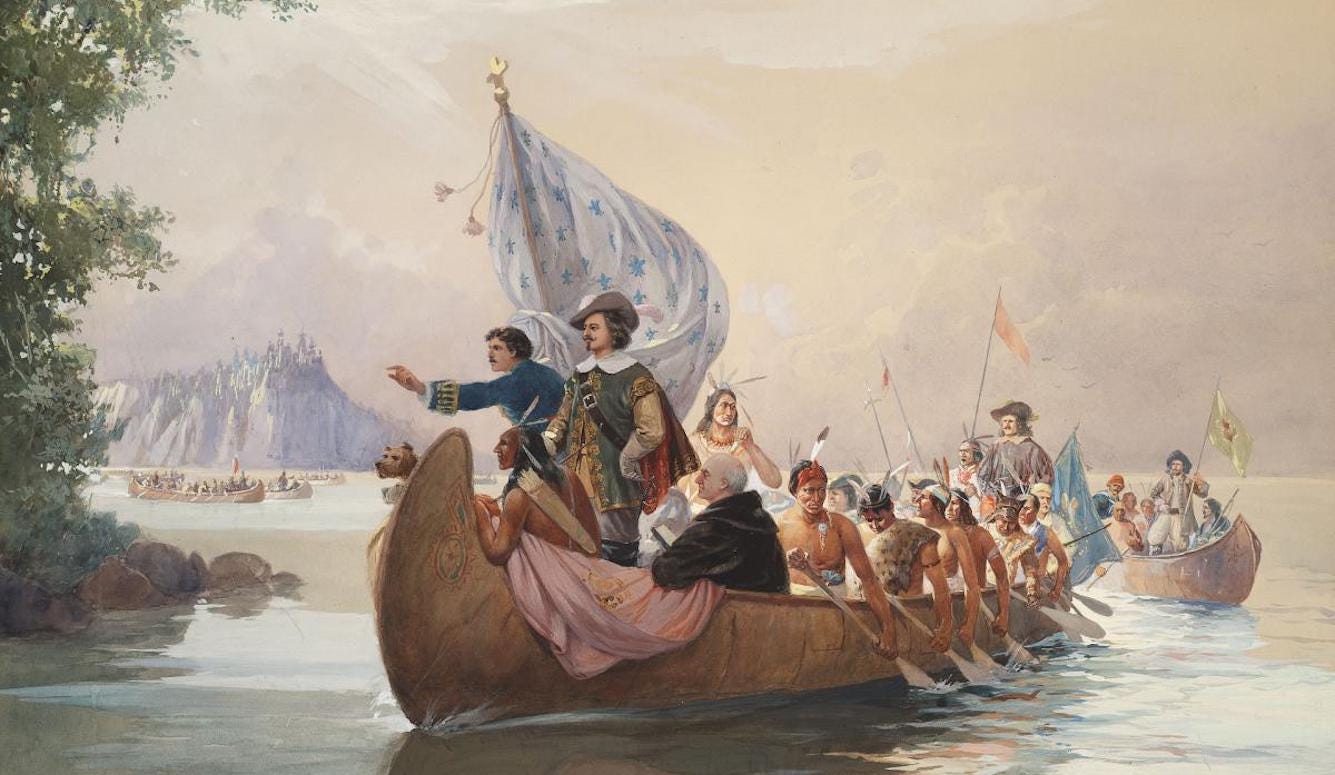
Champlain was then accompanied by sixteen Frenchmen—including one of the Récollets, Father Joseph, and some interpreters—on an expedition to Huronia. This was territory of the Huron Confederacy, between lakes Simcoe, Ontario, and Huron. Geographer Conrad Heidenreich explains some of the significance of the area from the French’s perspective:
[The Hurons were] a group of semi-sedentary, agricultural Indians, belonging to the larger family of Iroquoian-speaking peoples. With a population estimated at 21,000, in a territory some 340 square miles, Huronia was perhaps the most densely settled area of aboriginal Canada… the Huron and Algonquin groups controlled the access to the lands north of the Great Lakes, and, in particular, the resources of the Canadian Shield. Realizing this, the French were obliged to commit themselves to the Huron-Algonquian alliance.26
Champlain was fascinated and thrilled to be welcomed into Huron villages with hundreds of dwellings, as he made note of their wooden palisade defences, sometimes up to thirty-five feet high, and the well-tended farmland with large amounts of corn.


The land and people were fertile and agreeable, but maybe too much so for Champlain, as he recalled one sleepless night in a Huron village, “having gone outside the lodge to escape the fleas, which were very numerous and a great pest to us, a shameless girl came boldly up to me, offering to keep me company, which I declined with thanks, sending her away with gentle remonstrances.”27
As part of the negotiations back in Paris to fund his colonial expeditions, Champlain had become married to Hélène Boullé, the daughter of Nicolas Boullé, an influential and powerful secretary in the king’s household.
As married man, Champlain’s focus was not on removing clothing of his own but on bringing the technological and religious clothing of Europe to exchange with the Indigenous.
This was another one of the many ways that Champlain stood out among his peers.
Next, we’ll track Champlain’s travels deeper into the interior, and discover that superior technology was no guarantee of success in war. And see how the first families of New France brought life to the slowly growing settlement of Quebec.
H. P. Biggar, The Voyages of Jacques Cartier (Ottawa: Public Archives of Canada, 1924), 91.
Jean-François Lozier, Flesh Reborn: The Saint Lawrence Valley Mission Settlements through the Seventeenth Century, 306.
Éric Thierry, “Champlain and Lescarbot: An Impossible Friendship,” in Raymonde Litalien and Denis Vaugeois, eds., Champlain: The Birth of French America, trans. Käthe Roth (Montreal: McGill-Queen’s University Press, 2004), 125.
Samuel de Champlain, The Works of Samuel de Champlain, ed. H. P. Biggar, vol. 2 (Toronto: The Champlain Society, 1925), 22.
Champlain, Works, 2:24.
Marcel Trudel, The Beginnings of New France, 1524–1663, trans. Patricia Claxton (Toronto: McClelland and Stewart, 1973), 94.
Ibid, 95.
Champlain, Works, 2:57.
Marc Lescarbot, The History of New France, trans. W. L. Grant, 2 vols. (Toronto: The Champlain Society, 1907–1911), 2:334.
Champlain, Works, 2:34.
Gervais Carpin, “Migrations to New France in Champlain’s Time,” in Raymonde Litalien and Denis Vaugeois, eds., Champlain: The Birth of French America, trans. Käthe Roth (Montreal: McGill-Queen’s University Press, 2004), 170.
Geoffrey Parker, The Military Revolution: Military Innovation and the Rise of the West, 1500–1800 (Cambridge: Cambridge University Press, 1988), 17.
David Hackett Fischer, Champlain's Dream (New York: Simon & Schuster, 2008), 270.
Ibid, 269.
Ibid, 270.
Ibid, 283.
Trudel, Beginnings of New France, 106.
Carpin, “Migrations to New France,” 171.
For more on this see: Eric Nelson, “Expulsion,” in The Jesuits and the Monarchy: Catholic Reform and Political Authority in France (1590–1615) (Aldershot, England, and Rome: Ashgate and Institutum Historicum Societatis Iesu, 2005)
André Vachon, “Fléché (Flesche, Fleche, Fleuchy, Fleuche), Jessé (Jossé, Josué),” in Dictionary of Canadian Biography, vol. 1 (University of Toronto/Université Laval, 2003–), accessed August 12, 2026, https://www.biographi.ca/en/bio/fleche_jesse_1E.html.
Trudel, Beginnings of New France, 109.
Reuben Gold Thwaites, ed., The Jesuit Relations and Allied Documents: Travels and Explorations of the Jesuit Missionaries in New France, 1610–1791, vol. 2, Acadia: 1612–1614 (Cleveland: The Burrows Brothers Company, 1896), 89.
For more on these conflicts see: Joseph R. Wachtel, “‘A ‘Bon François’ Desirous of the Glory of the King’: Intra-Catholic Anti-Jesuitism and the Collapse of the Port Royal Mission, 1610–1613,” Acadiensis 49, no. 2 (Fall 2020): 34–57.
Trudel, Beginnings of New France, 116.
Champlain, Works, 3:26.
Conrad E. Heidenreich, Huronia: A History and Geography of the Huron Indians, 1600–1650 (Toronto: McClelland and Stewart, 1971), 15.
Champlain, Works, 3:46-48.